
A submission arrives from a broker. An underwriter reviews it and forms a judgment. That judgment becomes a policy. The policy sits until a claim arrives, and a claims handler reconstructs, often from scratch, the same risk picture the underwriter once held. Somewhere in this chain, the intelligence that existed at the point of underwriting has quietly disappeared by the time it is needed again at claims.
This is not a data problem in the way most insurers frame it. The data usually exists somewhere, in a PAS, a broker submission, an email thread, or a scanned form. What is lost is not the data itself but the reasoning applied to it. Every handoff between systems and teams strips away context: why a risk was priced the way it was, what exceptions were made and why, what the underwriter noticed that a form field cannot capture. The next person in the chain inherits the data but not the judgment, and has to rebuild it, imperfectly, under time pressure, often with less information than the person before them had.
The compounding cost is easy to underestimate because it never shows up as a single failure. It shows up as underwriting decisions that contradict a claims history no one flagged. It shows up as a compliance review that takes weeks because reconstructing the reasoning behind a decision means re-reading a submission no one has looked at since it was made. It shows up as a distribution channel that cannot, in the moment, explain why one broker's submissions receive better terms than another's with a similar risk profile. Individually, these look like operational friction. Collectively, they are the same failure, repeated at every handoff, at scale.
This is the problem the Yukthi AI framework for Insurance is built to solve. It has two parts: a canonical risk record that carries a risk's full context across the value chain, and a KNOW, UNDERSTAND, DECIDE reasoning layer that turns that context into decisions an insurer can defend. Together they let AI deliver practical value at each stage, from submission to settlement, rather than in isolated pockets.
The canonical risk record
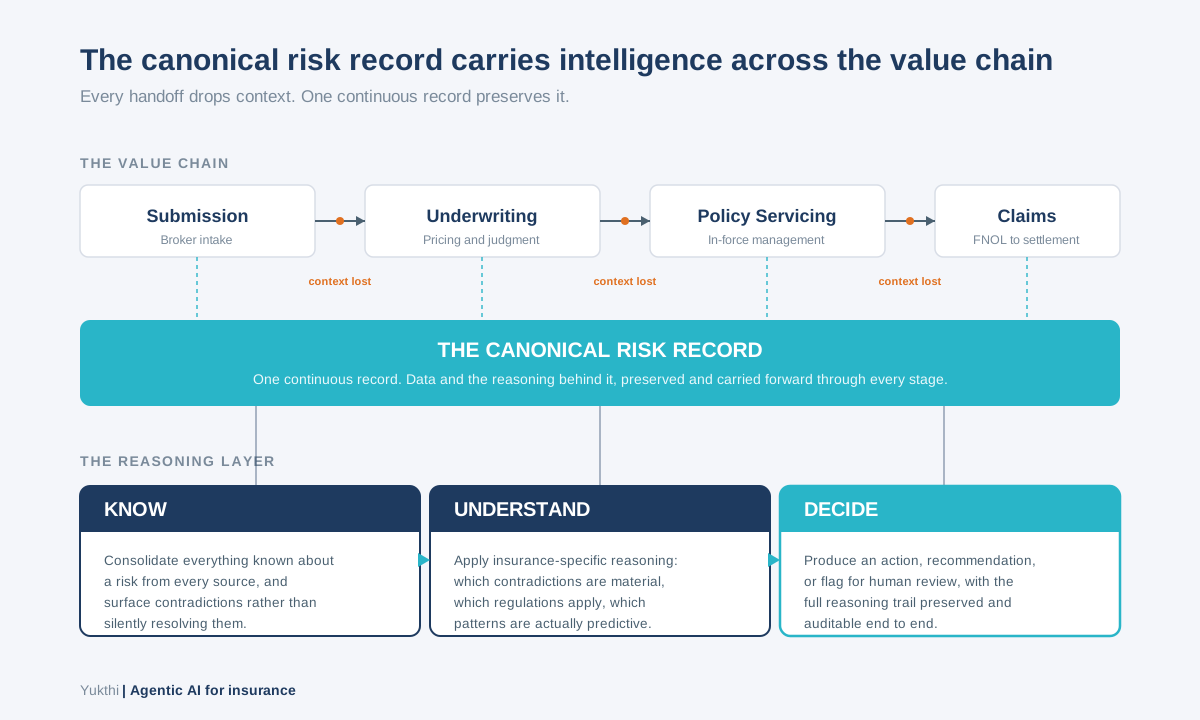
The starting premise of Yukthi's platform is that a risk should have a single continuous record, not a data trail scattered across systems that each partially reflects it. We call this the canonical risk record: a structured, continuously updated representation of a risk that carries its full context forward through every stage of the value chain, from submission through underwriting, policy servicing, and claims.
This is different from a data lake or a unified database, which most insurers already have some version of. A canonical risk record is not just storage. It preserves reasoning alongside data: what was known, what was inferred, what was flagged as uncertain, and why a decision was made a certain way. When a claim comes in, the system is not reconstructing the underwriting judgment from raw fields. It has access to the judgment itself.
KNOW, UNDERSTAND, DECIDE
Holding the right information is necessary but not sufficient. The canonical risk record is the substrate. The reasoning layer on top of it is what makes that substrate useful in a live decision. We structure this reasoning in three stages.
KNOW is the retrieval and consolidation stage. Before any judgment can be formed, the system needs an accurate, complete picture of what is actually known about a risk, pulled from every source that touches it, with contradictions between sources surfaced rather than silently resolved in favour of whichever source loaded last.
UNDERSTAND is where domain reasoning is applied to that picture. This is not generic summarisation. It requires knowing what matters in an insurance context specifically: which contradictions are material to a pricing decision, which regulatory obligations apply given a jurisdiction and a line of business, which patterns in a claims history are actually predictive rather than coincidental. This is the stage where domain depth either shows up or is exposed as absent.
DECIDE is where the reasoning becomes an action, a recommendation, or a flag for human review, with the full trail of how that conclusion was reached preserved and auditable. In a regulated industry, a decision that cannot be explained after the fact is a liability regardless of how accurate it was.
Why does generic AI stop at the surface
The framework also explains why horizontal AI tools underdeliver in insurance. A general-purpose tool can summarise a document, draft correspondence, or answer a question about a policy wording. It operates on whatever text is placed in front of it. What it cannot do is reach into the systems where the risk actually lives, reconcile a submission against a PAS record and a claims history, apply the regulatory logic of the jurisdiction and line of business, and produce a decision that holds up when a regulator or an auditor asks why.
Read against KNOW, UNDERSTAND, DECIDE; the limitation is precise. Generic tools perform a shallow version of KNOW on isolated documents, cannot perform UNDERSTAND because they lack the domain reasoning to judge what is material, and cannot make DECIDE defensible because they preserve no auditable trail. The gap is not model quality. It is architecture. An insurance-grade decision requires a system built around the canonical risk record and the reasoning layer above it, not a productivity assistant pointed at a file.
Using the framework
The value of a framework is that it travels. Any insurer can use KNOW, UNDERSTAND, DECIDE to interrogate an AI initiative before committing to it. Where does the system get its picture of the risk, and does it surface contradictions or bury them? Does it apply reasoning specific to insurance, or a generic pattern-matching dressed in insurance language? Can every decision it produces be explained and defended after the fact? An initiative that cannot answer all three is operating on data without intelligence and will lose that intelligence at the next handoff, exactly as the manual process does today.
This is the lens Yukthi builds to. Every component we ship is engineered against the canonical risk record and the KNOW, UNDERSTAND, DECIDE standard, so that AI deployed across underwriting, claims, distribution, and operations delivers decisions an insurer can trust and a regulator can audit.
If you are evaluating where AI can create defensible value across your insurance value chain, we would welcome the conversation.
Reach us at hello@yukthilabs.com.